
Personalized Blood Flow Restriction System (DELFI BFR: Blood Flow Restriction)
Therapists
Vincent Adams
John Pradier
Juliette Gallant
Julie Coupal
Émilie Lefrançois
Carolane Méthé
Modality Overview
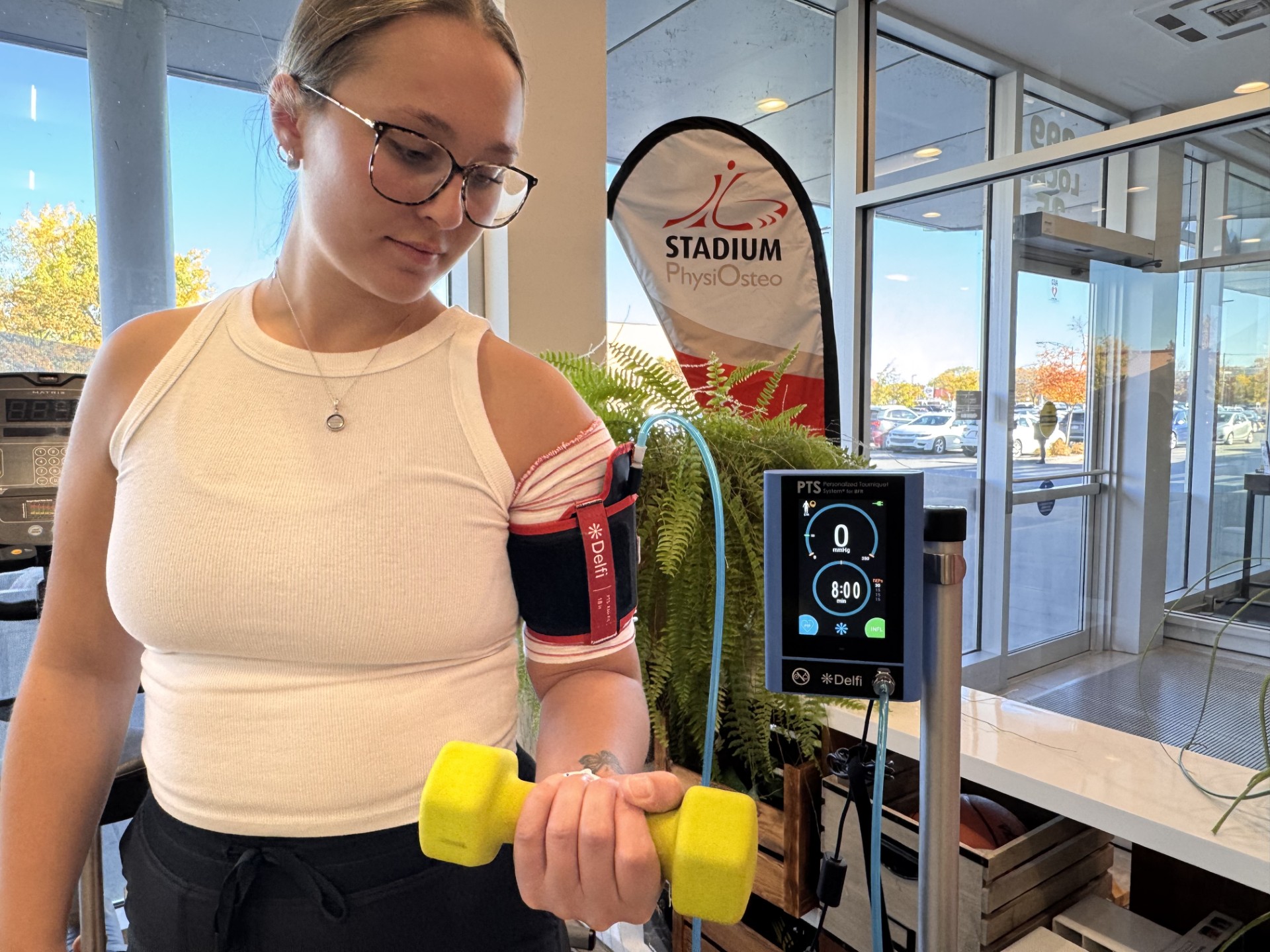
The DELFI Personalized Blood Flow Restriction (BFR) system is a modality that fully restricts venous blood flow and partially restricts arterial blood flow in the arm or leg. This creates a low-oxygen environment. In such an environment, muscles experience early fatigue due to the metabolic stress caused by limited oxygen availability. This environment mimics what occurs during high-intensity training, allowing us to reproduce the benefits of high-intensity exercise by combining BFR with low-intensity exercise.
The benefits of BFR include gaining muscle mass and strength with simple low-intensity exercises. Several studies have shown that low-intensity training combined with BFR is as effective as high-intensity training without BFR (Takarada, 2000; Slysz, 2016). BFR can also improve aerobic capacity (VO₂ max) and enhance vascular health. More specifically, BFR improves the heart’s ability to pump blood, making the cardiovascular system more efficient (Angelopoulos, 2023).
During a BFR appointment, you can expect to discuss your treatment goals and current condition with your therapist. Then, the BFR cuff will be placed around your arm or leg. The BFR system used at STADIUM Clinic features an automated cuff that adjusts the pressure based on the individual. Studies have shown that the use of an automated cuff is more effective and safer than a manual cuff (Younger, 2004). Depending on your goals and condition, you will perform low-intensity exercises for 20–40 minutes. You will likely feel pressure or muscle fatigue during the exercises, as the muscles are working much harder than they would without BFR.
Indications and Situations Where the Modality May Be Beneficial
BFR can be used in post-surgical rehabilitation or after a period of immobilization following an injury when high-intensity exercises are contraindicated. According to multiple studies, BFR allows for faster recovery or maintenance of muscle mass and strength compared to conservative treatments during rehabilitation (Gopinath, 2025).
To be effective, BFR must be combined with low-intensity exercises, which makes it especially useful for degenerative or age-related conditions such as osteoarthritis, osteoporosis, and sarcopenia (Ortiz, 2020). BFR can also be used by athletes to maximize muscle mass and strength (Wortman, 2021). In all these cases, high-intensity exercise can be avoided by using BFR, while still reproducing its benefits. BFR allows individuals to achieve results similar to traditional training while reducing stress on the joints, avoiding injuries, and minimizing fatigue.
BFR can also be used in patients with cardiovascular disease. Studies have reported improvements in cardiovascular parameters such as blood pressure through the use of BFR (Angelopoulos, 2023). This is done safely, without the need for high-intensity exercises that might strain the heart or joints.
Contraindications (Patterson, 2019)
- Deep vein thrombosis (DVT)
- Blood clotting disorders
- Poor blood circulation
- Varicose veins
- Peripheral vascular disease (PVD)
- Easy bruising
- Unstable heart rate
- Arrhythmia
- Cardiac pacemakers
- Pregnancy
Partner in your health and performances !